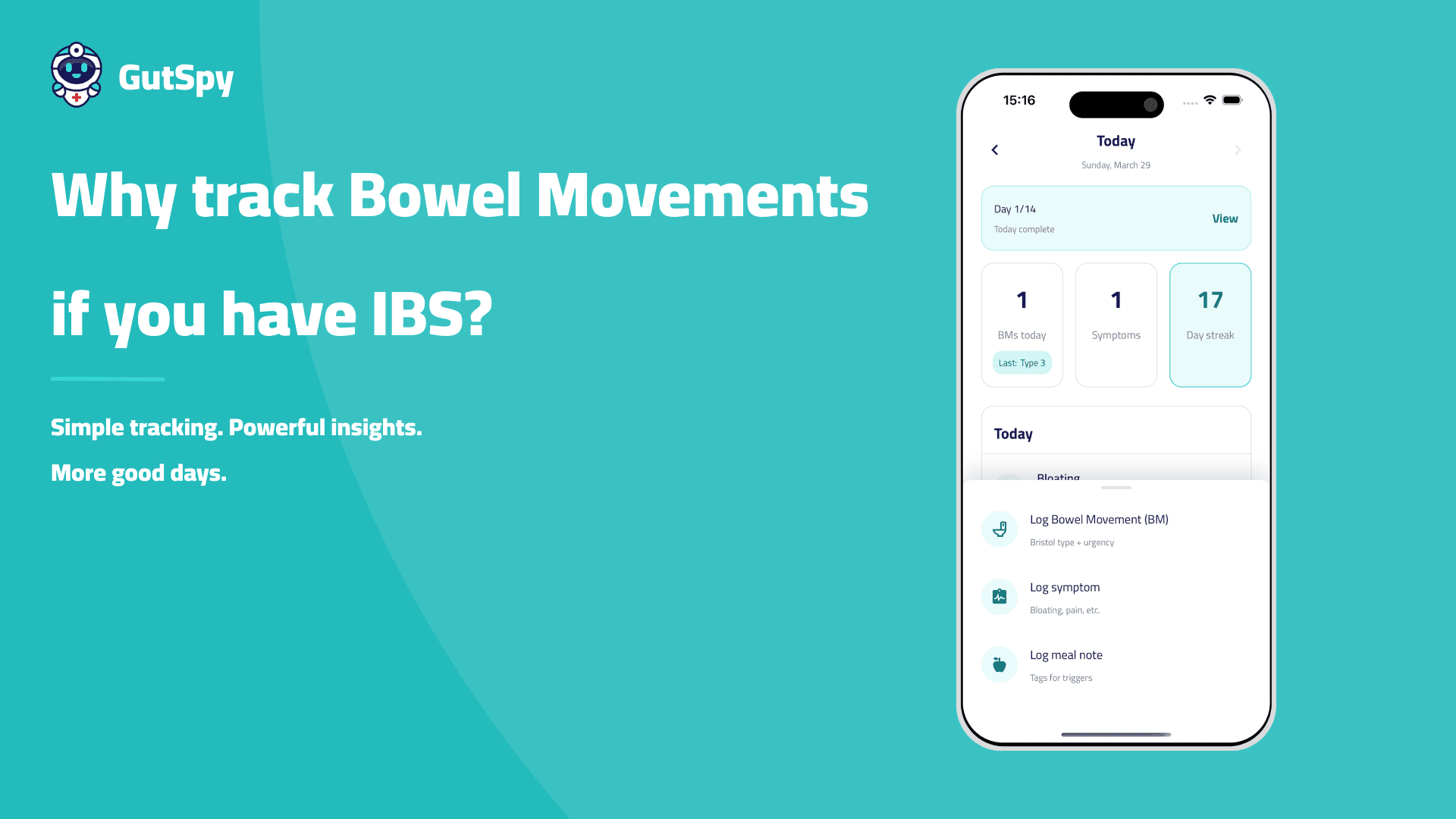
Tracking bowel movements can help you spot patterns in stool type, pain, bloating, urgency, meals, stress, and sleep. It cannot diagnose IBS on its own, but a simple IBS diary can make symptoms easier to understand and easier to describe during a medical appointment.
IBS symptoms can feel unpredictable, especially when constipation, diarrhea, urgency, bloating, and abdominal pain change from day to day. Tracking stool type alongside symptoms can help turn those changes into a clearer timeline.
This matters because IBS is usually assessed through symptom history, including abdominal pain related to bowel movements and changes in bowel movement frequency or stool appearance.
Key takeaways
- An IBS diary can help reveal symptom patterns over time.
- Useful details to track include stool type, urgency, pain, bloating, meals, stress, sleep, and routine changes.
- A 14-day tracking period is a practical place to start.
- Tracking cannot diagnose IBS, but it can make symptoms easier to explain to a doctor.
- Speak to a doctor if symptoms are new, severe, worsening, persistent, or linked with warning signs.
Who can benefit from an IBS symptom diary?
An IBS symptom diary may be useful if you already have IBS, suspect IBS, or are trying to understand recurring changes in stool type, urgency, bloating, abdominal pain, meals, stress, or sleep.
It may also help if your symptoms feel random, change from day to day, or seem linked to certain meals, stress, poor sleep, travel, skipped meals, or routine changes.
Tracking is especially useful when you want to move from vague notes like “my stomach has been bad” to a clearer pattern, such as “urgency happened after breakfast on several days” or “bloating was worse on days with constipation.”
When should you speak to a doctor before relying on tracking?
Tracking can help you understand patterns, but it should not delay medical advice if symptoms are new, severe, persistent, worsening, or unusual for you.
Speak to a doctor if you notice:
- Blood in your stool, bleeding from your bottom, or bloody diarrhea
- Black or tarry stools
- Unexplained weight loss
- Anemia or symptoms that may suggest anemia, such as shortness of breath, noticeable heartbeats, or paler-than-usual skin
- A hard lump or swelling in your tummy
- A major change in bowel habits that is unusual for you
According to the NHS IBS symptoms guidance, warning signs like these may point to something more serious than IBS.
How can tracking bowel movements help with IBS?
Tracking bowel movements can help you see whether symptoms are staying the same, improving, becoming more frequent, or shifting between constipation, diarrhea, and mixed patterns.
It can also help you notice whether symptoms appear near certain meals, stressful periods, poor sleep, travel, skipped meals, or routine changes.
For example, instead of saying, “My IBS has been bad lately,” you may be able to say, “I had urgency on five of the last fourteen days, bloating most evenings, and abdominal pain that often improved after a bowel movement.”
That kind of detail can make symptoms easier to understand and easier to discuss with a doctor or dietitian.
Can an IBS diary diagnose IBS?
No. An IBS diary cannot diagnose IBS by itself.
IBS is usually assessed through symptom history, medical evaluation, and patterns over time. According to the NIDDK guide to IBS diagnosis, doctors look for patterns such as abdominal pain related to bowel movements, changes in bowel movement frequency, and changes in stool appearance.
Clinical guidance, including the American College of Gastroenterology guideline for IBS, also supports the importance of medical assessment rather than relying on a single symptom or one tracking record alone.
A symptom log can still support that conversation by helping you explain:
- How often symptoms happen
- Whether abdominal pain is linked to bowel movements
- Whether symptoms lean toward constipation, diarrhea, or both
- Whether meals, stress, sleep, or routine changes appear near symptom flares
- Whether symptoms are improving, worsening, or staying the same
Tracking does not replace medical care, but it can make symptoms easier to describe and review.
What should you track in an IBS diary?
Track the details that help show how your bowel habits, symptoms, and daily routine fit together. A useful IBS symptom diary usually includes stool type, bowel movement frequency, urgency, abdominal pain, bloating, meals, stress, sleep, and routine changes.
Use this table as a quick guide to what to track in an IBS symptom diary and why each detail may matter.
| What to log | Why it matters |
| Stool type | Shows whether bowel habits lean toward constipation, diarrhea, or mixed patterns |
| Bowel movement frequency | Shows how often your bowel habits are changing |
| Urgency | Highlights whether sudden or difficult-to-control bowel movements are recurring |
| Abdominal pain | Shows whether pain appears before, during, or after bowel movements |
| Bloating | Shows whether bloating builds at certain times or before bowel changes |
| Incomplete evacuation | Records whether you often feel that you have not fully emptied your bowels |
| Meals and timing | Helps identify whether symptoms appear after certain meals or eating patterns |
| Suspected trigger foods | Helps show whether certain foods repeatedly appear near symptom flares |
| Stress and sleep | Shows whether lifestyle changes appear close to symptom changes |
| Routine changes | Helps explain whether travel, skipped meals, or schedule changes affect symptoms |
Table 1. This checklist is for organizing daily symptoms and bowel habits, not for diagnosis.
Stool type is one of the most useful details to log because it can show whether bowel habits lean more toward constipation, diarrhea, or mixed patterns. If you are unsure how to describe stool form, our guide to what IBS poop looks like on the Bristol Stool Scale explains the common stool types in more detail.
For broader IBS pattern tracking, combine stool type with urgency, pain, bloating, meals, stress, sleep, and routine changes. You do not need to track everything perfectly. The goal is to build a useful record that is simple enough to keep using.
For people who want one place for stool, symptoms, meals, and timeline review, an IBS tracker app can help keep these logs together without turning tracking into a long daily task.
How long should you track IBS symptoms?
A 14-day tracking period is a practical place to start.
Two weeks may be enough to begin noticing early trends in stool type, urgency, pain, bloating, meals, stress, sleep, and routine changes. You do not need perfect tracking to learn something useful. You just need enough consistency to see what tends to happen across multiple days.
If symptoms change a lot from week to week, tracking for longer than 14 days may give a clearer picture.
14-day IBS symptom tracking checklist
For the next 14 days, try to log the same core details each day:
- Bowel movements
- Stool type
- Urgency
- Abdominal pain
- Bloating
- Meals and meal timing
- Stress and sleep changes
- Travel, skipped meals, or routine changes
You do not need to track everything perfectly. The goal is to log enough consistent information to see what tends to happen across multiple days.
Try to make each entry quick. A useful daily log might answer: what happened, when it happened, how strong the symptoms felt, and what was happening around that time.
For people who want a structured 14-day approach, a 14-day IBS tracking program can support consistent logging and pattern review without making tracking feel overwhelming.
What patterns can an IBS diary reveal?
An IBS diary can reveal patterns that may not be obvious in the moment. These patterns usually appear over several days rather than from one single bowel movement.
Common patterns may include:
- Pain easing after a bowel movement
- Urgency happening more often after certain meals
- Bloating building before constipation or loose stools
- Symptoms appearing after poor sleep, stress, travel, or skipped meals
- Alternating constipation and diarrhea within the same week
If your logs often shift between hard stools, loose stools, or both, it may help to understand how stool-form patterns relate to IBS-C, IBS-D, and IBS-M. Our guide to IBS subtypes and the Bristol Stool Scale explains this in more detail.
These patterns do not prove a cause, but they can help you describe what keeps happening more clearly.
How should you review your IBS diary after 14 days?
After 14 days, review your diary for repeated patterns rather than isolated bad days. A useful review is about patterns, not perfection.
Start by asking:
- Which symptoms appeared most often?
- Did urgency, pain, or bloating happen at similar times of day?
- Did symptoms appear near certain meals, stress, poor sleep, travel, or skipped meals?
- Did pain often improve after a bowel movement?
- Did bowel habits lean more toward constipation, diarrhea, or mixed patterns?
- Are symptoms becoming more frequent, less frequent, or staying about the same?
- Were there any symptoms that felt new, unusual, or concerning?
You may also find it useful to group your notes into three simple categories:
| Pattern type | Example |
| Bowel habit pattern | Urgency appeared on several mornings |
| Symptom pattern | Bloating was worse on days with constipation |
| Lifestyle pattern | Symptoms were more noticeable after poor sleep or travel |
Table 2. Simple categories for reviewing IBS diary patterns after 14 days.
This kind of review can help you move from “my symptoms are random” to “these are the patterns I keep seeing.”
That does not mean you have found the cause of your symptoms. It simply gives you a clearer starting point for understanding what is happening and discussing it with a healthcare professional.
How can you keep an IBS symptom diary simple?
The easiest IBS symptom diary is usually the one you can stick with.
Start with the basics:
- Bowel movements
- Stool type
- Abdominal pain
- Bloating
- Urgency
- Meals
- Major stress or sleep changes
Once tracking becomes a habit, you can add more detail if needed. Simple daily tracking is usually more useful than detailed but inconsistent tracking.
Try to log close to the time symptoms happen rather than waiting until the end of the day. This can make your entries more accurate and easier to remember.
A good tracking system should help you:
- Log quickly
- Avoid overcomplicating the process
- Review changes over time
- Connect symptoms with possible triggers
- Summarize patterns clearly before appointments
How an IBS symptom log can help during an appointment
An IBS symptom log can make it easier to explain your symptoms clearly during a doctor or dietitian appointment.
Instead of trying to remember everything from the past few weeks, you can bring a simple summary of:
- How often bowel movements happened
- Whether stool patterns leaned toward constipation, diarrhea, or both
- How often urgency appeared
- When abdominal pain or bloating happened
- Whether pain improved after bowel movements
- Whether symptoms appeared near meals, stress, poor sleep, or routine changes
- Whether symptoms are new, worsening, or becoming more frequent
For example, instead of saying:
“My stomach has been bad.”
You may be able to say:
“Over the last 14 days, bloating happened most evenings, urgency happened after breakfast on several days, and pain often eased after a bowel movement.”
That kind of detail can help your healthcare professional understand your symptom pattern more clearly.
A simple tracking habit can make your symptom history easier to review and easier to share when you need support. A clinic-ready personal insights report can help turn your logs into a clearer format for discussion with a doctor or dietitian.
Medical note
This article is for educational purposes only and does not provide a diagnosis. An IBS diary cannot diagnose IBS and does not replace medical care. If symptoms are new, severe, unusual for you, persistent, getting worse, or linked with warning signs such as bleeding, black stools, anemia, or unexplained weight loss, seek medical advice.
Editorial note
This article was written for educational purposes and references guidance from NIDDK, NHS, and the American College of Gastroenterology.
FAQ
Can tracking bowel movements help with IBS?▼
Yes. Tracking bowel movements can help you spot patterns in stool type, urgency, pain, bloating, meals, stress, and sleep. It can also make symptoms easier to explain during a medical appointment.
Can an IBS diary diagnose IBS?▼
No. An IBS diary cannot diagnose IBS by itself. It can help show symptom patterns, but IBS diagnosis still requires medical evaluation.
What should I track along with bowel movements?▼
Track stool type, bowel movement frequency, urgency, abdominal pain, bloating, meals, suspected trigger foods, stress, sleep, and routine changes.
How long should I track IBS symptoms?▼
A 14-day diary is a practical place to start. Two weeks may be enough to notice early symptom patterns, while longer tracking may be useful if symptoms vary from week to week.
What should I do after tracking IBS symptoms for 14 days?▼
Review your diary for repeated patterns rather than isolated bad days. Look for links between bowel movements, urgency, pain, bloating, meals, stress, sleep, and routine changes.
Should I track IBS symptoms every day?▼
Daily tracking is usually more useful than occasional tracking because it gives you a clearer view of how symptoms change over time.
What should I bring to a doctor if I think I have IBS?▼
Bring a simple record of bowel movements, stool type, pain, bloating, urgency, symptom timing, meals, stress, sleep, and any major routine changes.
Can stress or sleep affect IBS symptoms?▼
Many people notice IBS symptoms change during stressful periods, poor sleep, travel, or routine changes. Tracking can help you see whether those factors appear near symptom flares.
What is the difference between an IBS diary and a food diary?▼
A food diary mainly tracks meals and possible food triggers. An IBS diary tracks food alongside bowel movements, stool type, urgency, pain, bloating, stress, sleep, and routine changes.
